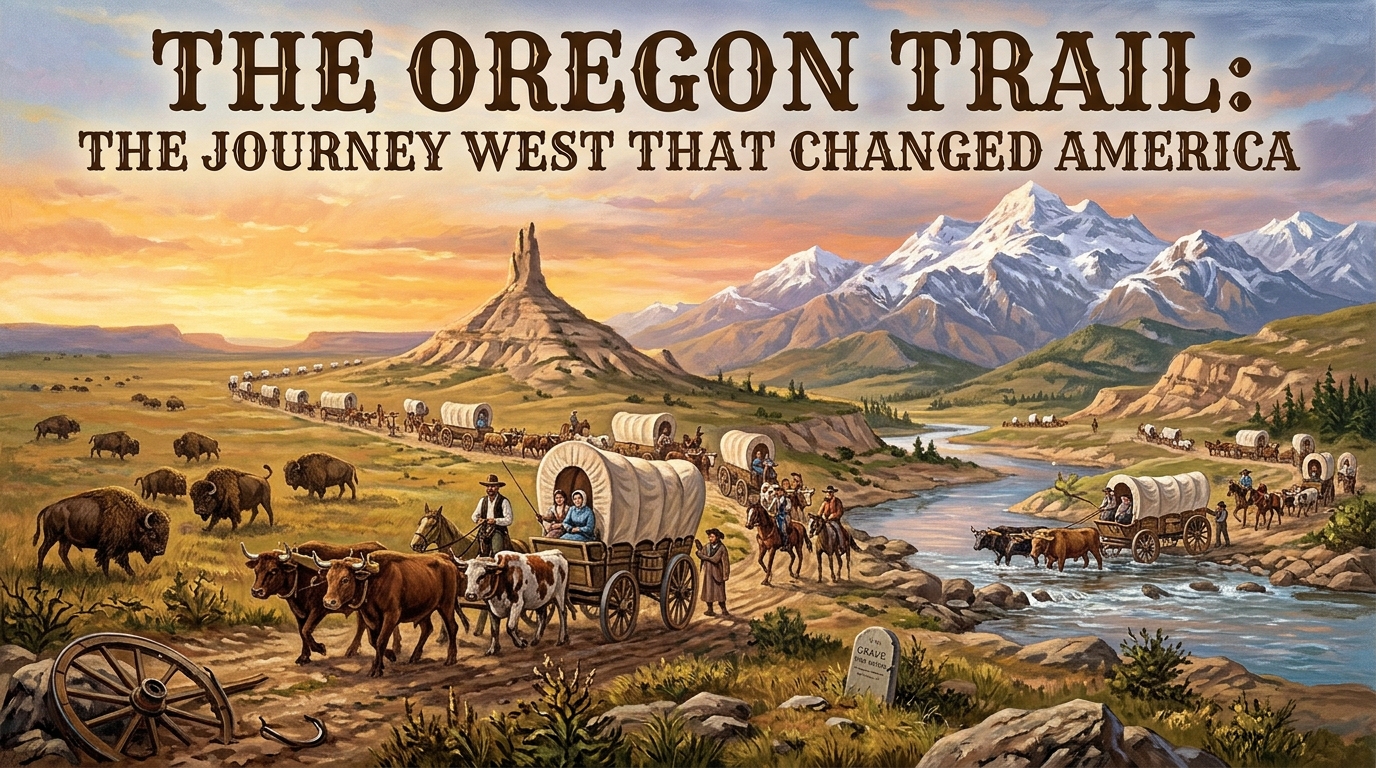
In the mid-19th century, a monumental chapter unfolded in American history—one that would permanently alter the geographical, political, and social landscape of the United States. This was the story of the Oregon Trail, a treacherous 2,170-mile overland route stretching from the Missouri River to the fertile valleys of Oregon. Between the 1840s and 1860s, more than 400,000 pioneers—men, women, and children—left behind their familiar lives, homes, and security to embark on a perilous journey into the unknown. It was not merely a migration; it was an epic tale of courage, endurance, tragedy, and the unyielding human desire for a better life.
Chapter 1: The Call of the West and “Manifest Destiny”
By the 1840s, the concept of “Manifest Destiny” had gripped the American imagination. This ideology held that the United States was divinely ordained to expand across the North American continent, from the Atlantic Ocean to the Pacific.
At the same time, economic hardship, financial panics, and overcrowding plagued the eastern states. Reports began circulating of a lush, fertile paradise on the West Coast known as the Oregon Country (comprising modern-day Oregon, Washington, Idaho, and parts of Wyoming and Montana). Missionaries and early fur trappers sent back glowing accounts of rich farmland, gentle climates, abundant timber, and vast rivers.
For thousands of struggling families, the promise of free land and a fresh start outweighed the extreme dangers of crossing an unexplored continent. Thus began the sweeping movement known as “Oregon Fever.”
Chapter 2: Preparation and the Jumping-Off Points
The journey began every spring, usually between April and May, at various “jumping-off” towns along the Missouri River—most notably Independence and Saint Joseph, Missouri. Timing was critical: pioneers had to wait until spring grass grew high enough to feed their livestock, but they also had to reach the western mountain passes before winter snows trapped them.
Preparation required immense capital and careful planning. A typical family needed:
- The Covered Wagon (“Prairie Schooner”): A sturdy wooden wagon fitted with a canvas hood treated with oil or wax to repel rain.
- Draft Animals: Oxen were preferred over horses or mules because they were stronger, cheaper, less prone to straying, and could survive on prairie grass.
- Supplies: Each adult required roughly 200 pounds of flour, 150 pounds of bacon, 10 pounds of coffee, 20 pounds of sugar, and 10 pounds of salt, alongside cooking utensils, tools, hunting gear, and medical supplies.
Pioneers organized themselves into wagon trains led by an elected captain or an experienced guide. These groups established strict rules, guard duties, and daily routines essential for survival.
Chapter 3: The Route and Landmarks
The trail wound through six modern-day states: Missouri, Kansas, Nebraska, Wyoming, Idaho, and Oregon. Along the way, iconic geological landmarks served as vital markers measuring their grueling progress:
- Chimney Rock (Nebraska): A towering spire visible from miles away, signaling that the flat Great Plains were giving way to the rocky terrain of the West.
- Scott’s Bluff (Nebraska): Dramatic clay and sandstone cliffs that offered a dramatic backdrop to the hard journey.
- Independence Rock (Wyoming): Known as the “Register of the Desert,” pioneers carved their names into this massive granite dome. Wagons strived to reach Independence Rock by the Fourth of July to ensure they were on track to cross the mountains before winter.
- South Pass (Wyoming): A broad, gentle valley through the Rocky Mountains. Crossing the Continental Divide at South Pass was a psychological milestone, taking travelers from the Atlantic watershed to the Pacific.
Chapter 4: Hardships, Disease, and Danger
Popular history often romanticizes the trail, but the reality was brutal and unforgiving.
Disease and Death
Contrary to popular belief, conflicts with Native American tribes were rare; in fact, indigenous peoples frequently traded with and aided travelers. The true killers were disease, accidents, and exhaustion.
- Cholera: Waterborne cholera was the single deadliest threat on the trail. A person could be healthy in the morning and dead by nightfall.
- Other Illnesses: Smallpox, dysentery, measles, and typhoid fever claimed thousands of lives.
- Accidents: Drownings during river crossings, wagon runovers, accidental gunshot wounds, and snakebites were constant dangers.
Estimates suggest that 1 in 10 emigrants died along the trail—roughly 20,000 to 30,000 graves lined the path, earning it the grim nickname “the longest graveyard in the world.”
The Daily Grind
A pioneer’s day began at dawn. Most travelers walked the entire distance on foot to avoid overloading the oxen pulling their heavily laden wagons. They covered 15 to 20 miles a day, enduring scorching heat, blinding dust storms, torrential rains, and sudden hail.
At night, wagons were arranged in a circle (a “corral”) to keep livestock contained and provide a defensive barrier against predators or threats.
Chapter 5: Crossing the Final Barriers
After months of grueling travel through the high deserts of Idaho and along the Snake River, the hardest test lay ahead: the Cascade Mountains.
To reach the Willamette Valley in Oregon, emigrants faced two perilous options:
- The Columbia River Route: Rafting down the treacherous rapids of the Columbia River gorge, where many drowned or lost all their possessions.
- Barlow Road: Built in 1846, this steep, rugged land path around Mount Hood allowed wagons to bypass the river, though it required clearing dense forests and descending terrifyingly steep mountain slopes.
Chapter 6: Legacy and Transformation
By the late 1860s, the completion of the First Transcontinental Railroad in 1869 made the Oregon Trail obsolete. What once took six grueling months on foot could now be accomplished in a matter of days by train.
However, the legacy of the Oregon Trail remains profound:
- Geopolitical Transformation: The flood of American settlers firmly established U.S. territorial claims in the Pacific Northwest, leading to the settlement of the Oregon Boundary dispute with Great Britain in 1846.
- Economic Expansion: Settlers developed rich agricultural industries, timber production, and trade hubs that laid the foundation for modern western cities.
- Cultural Symbol: The trail became the ultimate symbol of American perseverance, pioneering spirit, and westward expansion.
The Oregon Trail was not just a road west—it was a journey that forged a nation’s identity and reshaped the map of North America forever