
The Boston Massacre: The Night That Changed Colonial America
March 5, 1770 — Boston, Massachusetts
On the evening of March 5, 1770, a tense confrontation between British soldiers and residents of Boston ended with gunfire. Five civilians were killed, and the incident soon became known throughout the American colonies as the Boston Massacre.
The event happened during a period of growing disagreement between Britain and its North American colonies. Taxes, trade regulations, military occupation, and questions about political representation had created deep tensions. Boston had become one of the most politically active cities in the colonies, and British troops were stationed there to help maintain order.
A City Full of Tension
Boston in 1770 was not a peaceful place.
Many colonists were angry about British policies, including taxes and the presence of British troops. Soldiers and civilians lived and worked in close proximity, and arguments between them were not unusual.
On the night of March 5, a dispute involving a British sentry developed into a larger confrontation. More residents gathered around the soldiers, and the situation became increasingly difficult to control.
The soldiers eventually fired their weapons.
Five people died, including Crispus Attucks, Samuel Gray, James Caldwell, Samuel Maverick, and Patrick Carr.
The Famous Image
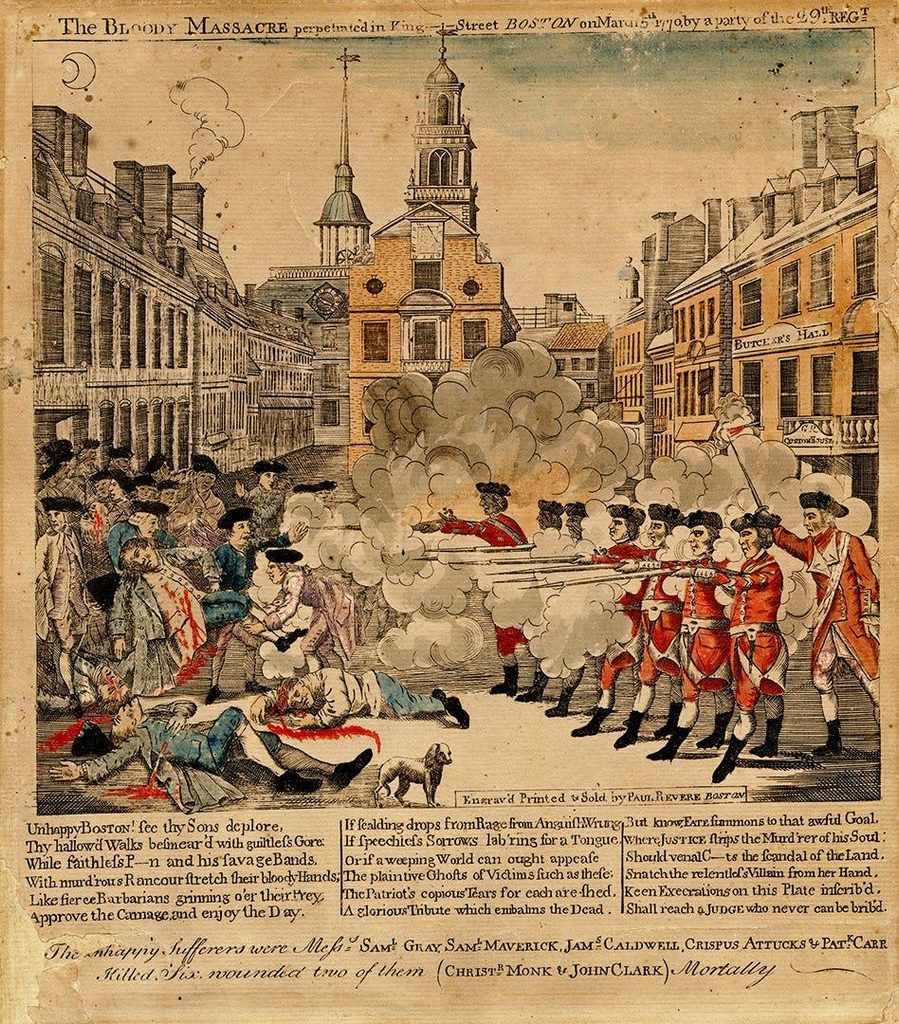
The image above is one of the most famous visual representations of the event.
It was created by Paul Revere in 1770, based on an engraving by Henry Pelham. The National Gallery of Art identifies the work as The Boston Massacre, an engraving with hand coloring. The museum also notes that the image is in the public domain.
The engraving presents the British soldiers firing toward civilians in a dramatic scene.
But historians should remember that this was not a photograph.
It was a political print created during a period of intense conflict. Its purpose was not simply to document the event like a modern news photograph. Images such as this helped shape public opinion.
The Trial
The soldiers involved in the shooting were arrested and eventually put on trial.
John Adams, who later became the second president of the United States, participated in the soldiers’ defense.
The trial demonstrated that the circumstances of the shooting were disputed. Witnesses gave different accounts, and lawyers debated what had happened in the moments before the soldiers fired.
Several soldiers were acquitted. Two were convicted of manslaughter and received reduced punishment.
The legal proceedings became an important part of the historical record because they provide evidence beyond the famous engraving.
How the Event Became a Symbol
The Boston Massacre quickly became a powerful political symbol.
Patriot leaders used the deaths to criticize British military authority. Newspapers and pamphlets spread descriptions of the incident throughout the colonies.
The Paul Revere engraving became especially influential because it provided a dramatic visual representation that ordinary readers could immediately understand.
The incident therefore became larger than the original confrontation.
It became part of the political argument over whether Britain had the right to maintain troops in the colonies and how much authority Parliament should have over colonial life.
The Road Toward Revolution
The Boston Massacre did not single-handedly cause the American Revolution.
The dispute between Britain and the colonies had already been developing for years.
However, the event became one of the important moments remembered by supporters of independence.
Five deaths in a Boston street were transformed into a powerful political story about government, military power, taxation, and colonial rights.
Within a few years, the colonies and Britain would be at war.
Why It Still Matters
The Boston Massacre is important because it shows how historical events can have two different dimensions.
There is the event itself: a confrontation that ended with five deaths.
Then there is the story that people created around the event.
The engraving, newspapers, speeches, court proceedings, and later historical accounts all influenced how generations understood what happened.
Studying the event therefore requires more than looking at one famous picture.
The picture is valuable evidence, but it must be considered alongside other historical sources.
Conclusion
The Boston Massacre took place more than 250 years ago, but its story remains important in American history.
It demonstrates how political tensions can turn a local confrontation into a national symbol.
It also reminds us that historical images are not always neutral records. They can influence how people remember events.
For anyone studying the American Revolution, the Boston Massacre provides an important starting point for understanding the tension between Britain and its American colonies during the years before independence.